Addressing Ableism in Education
(Higher Education & K–12)
Advancing inclusive educational systems that move beyond compliance toward equity, belonging, and academic success.
Overview
Examining how ableism shapes access, opportunity, and educational outcomes.
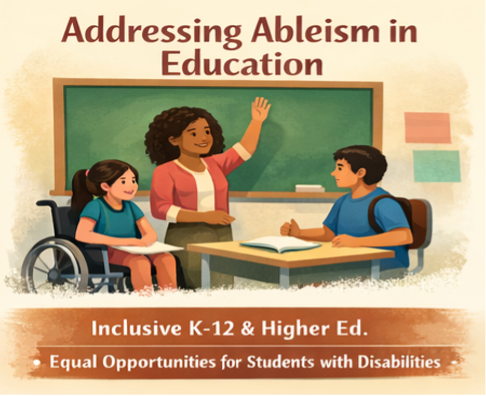
Addressing Ableism in Education (Higher Education & K–12) focuses on the redesign of educational environments that move beyond compliance toward equity, belonging, and academic success. The Center develops strategies to create and sustain inclusive educational environments and addresses disparities in educational outcomes for students with disabilities.
This work examines how ableism is embedded in educational systems, policies, and practices across K–12 and higher education, contributing to persistent disparities in access, retention, achievement, and postsecondary outcomes for students with disabilities and chronic conditions. Through interdisciplinary research, policy analysis, and practitioner-informed strategies, the Center advances inclusive models of teaching, learning, assessment, and attendance that recognize fluctuating health, neurodiversity, and diverse learning needs.
Academic Focus
Research and policy analysis addressing systemic barriers in education.
- Research on attendance, assessment, discipline, and accountability policies and their disparate impact on disabled students.
- Evaluation of IDEA, ADA, Section 504, and higher education disability services implementation gaps.
- Development of inclusive pedagogical frameworks and institutional accountability metrics.
Community & Institutional Partnerships
Collaborating with institutions and communities to test and scale inclusive models.
- Collaborations with school districts, HBCUs, MSIs, disability cultural centers, parent advocacy groups, and teacher preparation programs.
- Practitioner fellowships and pilot programs to test inclusive policy models.

Transportation and Accessibility
Supporting transportation systems that enable independence, dignity, and full community participation.
Transportation and Accessibility recognizes transportation as a critical civil rights and equity issue, acknowledging that inaccessible systems limit participation in education, employment, healthcare, and civic life. The Center investigates both physical and digital mobility barriers across public and private transportation systems.
Academic Focus
- Research on accessible transit, paratransit systems, and emerging mobility technologies.
- Policy analysis of local, national, and international transportation accessibility standards.
- Evaluation of safety, reliability, and user experience for disabled riders.
Community & Government Partnerships
- Partnerships with transit authorities, urban planners, disability riders’ unions, and technology developers.
- Community-based research centered on lived experience and rider-led data collection.

Global Ableism, Human Rights, and Humanitarian Response
Advancing disability as a core global human rights issue.
Globally, ableism remains an under-addressed, systemic issue, often rooted in historical, colonial, and capitalist structures that devalue those who do not fit narrow definitions of productivity and worth. With approximately 1.3–1.4 billion people worldwide living with disabilities—80% in low- and middle-income countries—the Center addresses global disparities in law, policy, and practice.
Academic Focus
- Comparative analysis of disability laws, including implementation gaps in the UN Convention on the Rights of Persons with Disabilities (CRPD).
- Research on disability inclusion in humanitarian crises, conflict zones, and climate-related emergencies.
- Examination of Global North–South inequities in disability policy and resource allocation.
Global Partnerships
- Collaborations with international NGOs, universities, humanitarian agencies, and disabled people’s organizations (DPOs).
- Support for disability-inclusive emergency planning and policy transfer across regions.

Global Ableism, Human Rights, and Humanitarian Response
Promoting inclusive employment ecosystems and economic justice.
This pillar addresses ableism in labor markets and economic systems that systematically exclude people with disabilities from meaningful employment, career advancement, and financial security. The Center explores how hiring practices, workplace norms, benefits systems, and productivity standards reinforce economic marginalization.
Academic Focus
- Research on disability employment gaps, wage disparities, and underemployment.
- Policy analysis of ADA enforcement, reasonable accommodation practices, and workforce development systems.
- Examination of the intersections between disability, poverty, and social safety net policies.
Community & Industry Partnerships
- Partnerships with employers, workforce boards, unions, entrepreneurship hubs, and disability-led organizations.
- Development of inclusive hiring toolkits, accommodation audits, and leadership training.
Ableism and Intersectionality
Addressing how multiple systems of oppression shape lived experience.
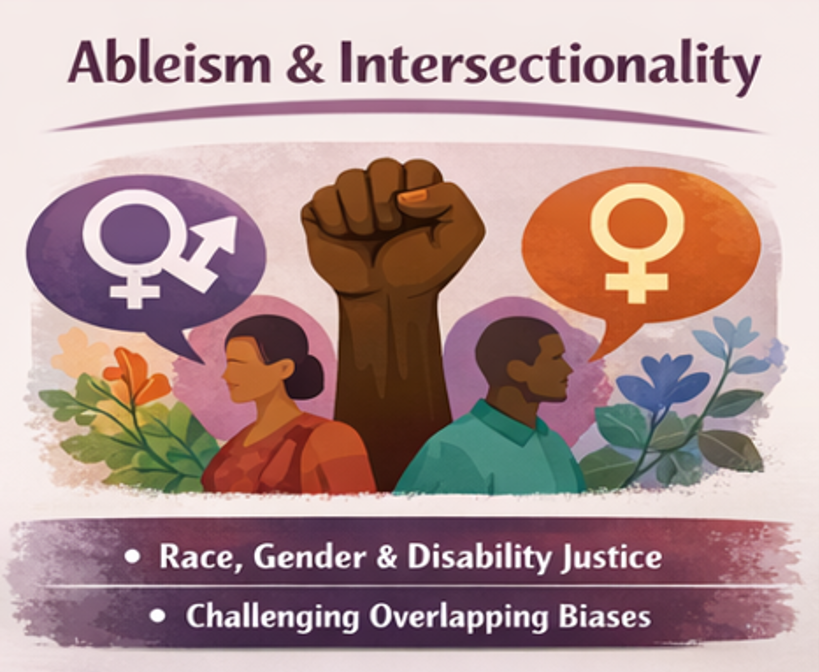
Ableism and Intersectionality centers the understanding that ableism does not operate in isolation but is deeply intertwined with racism, sexism, classism, xenophobia, and other systems of oppression. The Center prioritizes research and policy solutions that reflect the lived realities of disabled people from marginalized communities.
Academic Focus
- Intersectional research on disability, race, gender, immigration status, and socioeconomic inequality.
- Analysis of how policies compound exclusion for disabled people of color, women, LGBTQ+ individuals, and immigrants.
- Development of frameworks grounded in disability justice and critical race theory.
Community Partnerships
- Partnerships with grassroots organizations, faith-based groups, cultural institutions, and advocacy networks.
- Community-led research, storytelling, and policy co-creation initiatives.
How This Work Shows Up in Practice
Turning research and policy into meaningful, real-world change.
Research & Policy Development
What we study and why it matters
- Examining attendance, assessment, discipline, and accountability policies and their impact on disabled students.
- Identifying gaps in the implementation of IDEA, ADA, Section 504, and higher education disability services.
- Developing inclusive pedagogical frameworks and institutional accountability metrics that support equitable outcomes.
Partnerships & Pilot Programs
Testing and strengthening inclusive models
- Collaborating with school districts, HBCUs, MSIs, and disability cultural centers.
- Engaging educators, practitioners, and advocates through fellowships and pilot initiatives.
- Co-creating solutions with communities to ensure policies reflect lived experience.
Impact & Outcomes
What change looks like
- More inclusive learning environments that recognize neurodiversity, fluctuating health, and varied learning needs.
- Improved access, retention, and academic success for students with disabilities and chronic conditions.
- Policy and practice shifts grounded in research, equity, and community partnership.